

Global buyers are paying closer attention to hose reliability, not only purchase price. Corrugated Suction Hose supports demanding transfer work in agriculture, construction, mining, water management, and industrial processing. Its flexible corrugation helps the hose bend around pumps, tanks, and uneven ground. Reinforced walls also reduce collapse risks under suction conditions. Small details matter.
Industry reports show why supplier evaluation deserves more discipline. Grand View Research estimated the global industrial hose market at approximately USD 16 billion in 2023 and expects continued growth through the decade. Its analysis links demand to infrastructure investment, manufacturing activity, and fluid-handling requirements. MarketsandMarkets also identifies agriculture, chemicals, construction, and water treatment as important application sectors for industrial hose products. These reports do not always separate corrugated suction hose from wider hose categories. That limitation should be stated clearly.
A credible supplier must provide more than attractive photographs and fast quotations. Buyers should examine operating temperature, pressure ratings, abrasion resistance, reinforcement structure, connector compatibility, and documented quality controls. ISO 9001 certification can support process confidence, but it does not automatically prove product performance. Sample testing remains valuable. Check the hose beside the pump.
This Top 10 Corrugated Suction Hose Suppliers list considers manufacturing experience, export capability, technical documentation, customization, testing practices, and after-sales support. It also recognizes practical concerns, including lead times, minimum order quantities, and regional service coverage. The ranking is not perfect, because supplier data changes and public claims require verification. Still, it offers a practical starting point for global purchasers seeking safer, longer-lasting, and more predictable hose solutions.
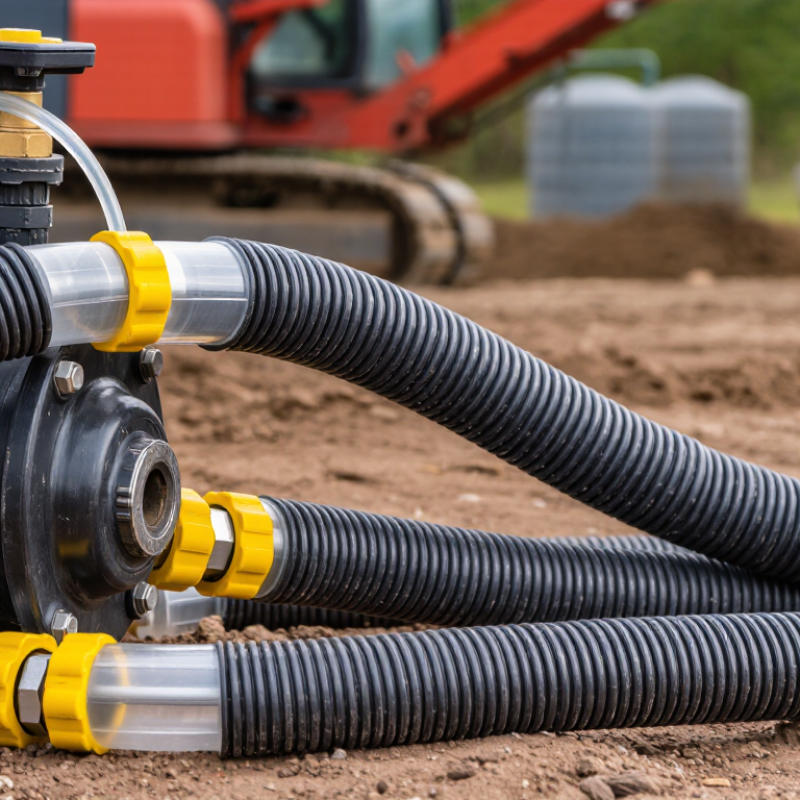
Corrugated suction hoses are flexible pipes designed to draw and transfer liquids, slurries, and some dry materials. Their spiral reinforcement helps the hose resist collapse under negative pressure. The corrugated outer wall improves flexibility around pumps, tanks, and uneven ground. Inside, a smooth bore can reduce turbulence and material buildup. Some designs include grounding wires, abrasion-resistant liners, or transparent walls for flow inspection.
Their core function is reliable suction during loading, draining, irrigation, dewatering, and industrial transfer. A suitable hose must match the pump’s vacuum rating, working pressure, temperature, and material compatibility. Diameter also matters. A narrow hose may increase friction and reduce pump performance. A hose that is too long can create unnecessary bends and pressure loss. Field experience shows that fittings often fail before the hose itself. This point is easy to overlook. Selection is not always neat; real sites contain sharp edges, muddy surfaces, and sudden movement.
Tips: Measure the connection before ordering. Check the minimum bend radius. Inspect the hose after each demanding shift. Look for flattened sections, cracks, exposed reinforcement, or loose fittings. Do not rely only on appearance. A hose can look sound while its inner liner is already worn. Keep suction lines as short and straight as practical. Secure them against dragging and excessive vibration. Record operating temperature and fluid type, because memory becomes unreliable during urgent maintenance.
Global buyers comparing corrugated suction hose suppliers should begin with measurable specifications, not catalog photographs.
The 2024 industrial hose market analysis by Grand View Research identifies construction, agriculture, and material handling as major demand sectors. These applications require different suction pressures, bending radii, and reinforcement designs.
Check the working pressure and vacuum rating separately. A hose marked “heavy duty” proves little. Request test values at the intended temperature. ISO 4649 measures abrasion through volume loss, reported in cubic millimetres. Lower loss usually indicates better wear resistance. Confirm the material, such as PVC, TPU, or rubber, and ask for chemical compatibility data. EN 12115 provides a useful reference for chemical hose construction and electrical properties. It should not replace application testing.
Inspect the corrugation depth, wall thickness, and minimum bend radius. A tighter bend may reduce installation space, but it can also increase fatigue at the fitting. Measure the actual bore, because nominal diameter differences can restrict airflow. Coupling type, gasket material, and clamp torque deserve equal attention. According to the U.S. Bureau of Labor Statistics, transportation and material-moving work recorded over 1.8 million nonfatal injury and illness cases in 2022; secure connections are not a minor detail. A neat spreadsheet can still mislead. Suppliers should provide batch traceability, pressure-test records, and sample approval before large orders.
Fancy wording cannot replace evidence.
The top 10 corrugated suction hose suppliers for global buyers should be judged by market strength, not advertising volume. A practical ranking considers production capacity, export reach, quality control, and delivery consistency. Strong suppliers usually maintain stable access to PVC, rubber, steel wire, and reinforced compounds. They also provide traceable batch records and clear technical data.
The leading ten typically include large manufacturers, regional specialists, and flexible custom-production factories. Their market strength appears in different ways. Some hold extensive warehouse stock near major ports. Others support difficult sizes, food-grade applications, chemical transfer, or agricultural pumping. Several offer private labeling and short production runs. That helps smaller distributors compete. Still, capacity can hide weaknesses. A factory may produce thousands of meters daily but respond slowly to complaints. Buyers should inspect pressure ratings, bend radius, temperature limits, and coupling quality before ordering.
Reliable suppliers explain testing methods instead of using vague claims. They should provide sample hoses, inspection reports, and realistic lead times. Experience matters here. A hose that looks durable on a showroom floor may flatten during continuous suction. Field feedback remains valuable, even when it is inconvenient. Payment terms, replacement policies, packaging, and port documentation also reveal operational maturity. Market strength changes with raw material costs and shipping conditions. Therefore, the strongest supplier today may not remain the safest choice next year.
Quality begins with a clear technical specification, not a polished catalogue. Confirm the hose’s inner diameter, wall thickness, working pressure, vacuum rating, temperature range, and minimum bend radius. Ask how the supplier controls wire spacing during extrusion. Uneven spacing can cause collapse under suction. Request batch-level test reports for pressure, vacuum resistance, abrasion, and dimensional accuracy. Small details matter.
Compliance needs evidence. Verify the supplier’s quality system, production records, calibration certificates, and material declarations. ISO 9001 certification can show process control, but it does not guarantee every hose is reliable. Check whether testing follows relevant international standards, such as ISO 1307, where applicable. For special uses, confirm chemical compatibility and any required food-contact, environmental, or regional documentation. Certificates should match the exact hose construction and production batch.
Visit the factory when order volume justifies the cost. Observe raw-material storage, helix placement, curing conditions, and final inspection. Ask for samples from different lots, not only selected pieces. A useful audit question is simple: “What happens when a test fails?” Strong suppliers explain containment, rework, traceability, and corrective action. Weak answers are revealing. I would also verify packaging, labeling, pallet protection, and export documents before shipment. One overlooked issue remains common: suppliers may quote a lower price by changing reinforcement or tolerances without clearly stating it. Require written approval for every design change.
Global buyers comparing the top 10 corrugated suction hose suppliers should examine performance before price. The global industrial hose market was valued at about USD 13.7 billion in 2023, according to Grand View Research. Demand is expanding across agriculture, construction, mining, and fluid transfer. That growth can attract inexperienced suppliers.
Check hose construction, not only catalog photos. Ask for tube material, reinforcement layers, vacuum rating, temperature range, bend radius, and coupling compatibility. ISO 1307 provides useful dimensional and testing guidance for rubber and plastic hoses. For petroleum applications, EN 1765 may offer a more relevant benchmark. A capable supplier should provide batch traceability, test records, and clear working-pressure limits. Do not accept “heavy duty” without numbers. It sounds convincing, but it proves little.
Tips: Request a sample cutaway and a pressure-test report. Compare the actual inner diameter with the quoted size. Confirm whether the supplier tests the complete assembly, including couplings. Freight data matters too. A hose that arrives flattened, dusty, or poorly capped may lose service life before installation. Review replacement lead times, minimum order quantities, warranty terms, and technical support across time zones. A small pilot order can reveal stiffness, odor, fitting accuracy, and packing quality. I would also ask for references from similar operating conditions, although references alone should not decide the purchase. Performance records are stronger evidence.
Anonymized supplier comparison based on commonly verified purchasing criteria. Product ratings and commercial terms are indicative benchmarks; buyers should confirm current specifications, test reports, certificates, and quotations directly with each supplier.
| Rank | Supplier Profile | Primary Supply Region | Typical Corrugated Suction Hose Offering | Common Product Range | Typical Performance Data | Material and Construction | Quality Documents to Request | Best Fit for Global Buyers | Overall Score |
|---|---|---|---|---|---|---|---|---|---|
| 1 | Supplier Profile A | Western Europe | Heavy-duty agricultural and industrial suction hose with smooth internal bore | 50–203 mm ID 10–30 m coils | Approx. −0.9 to +5 bar working pressure depending on size; typical working temperature around −30°C to +60°C | Flexible PVC or thermoplastic compound with rigid spiral reinforcement; abrasion-resistant variants available | Batch traceability, dimensional inspection, pressure test records, material declaration, REACH/RoHS statements where applicable | Buyers needing consistent documentation, repeatability, and medium-to-heavy-duty service | 9.2/10 |
| 2 | Supplier Profile B | East Asia | OEM-focused corrugated suction and delivery hose for agriculture, irrigation, and water transfer | 25–200 mm ID Custom cut lengths | Typical vacuum capability up to approximately 0.8–0.9 bar; pressure ratings vary by diameter and reinforcement | PVC helix with soft wall; transparent, blue, green, and custom-color compounds commonly available | Factory inspection report, sample approval record, hose wall and inner-diameter measurements, packing list, certificate of origin | Importers prioritizing customization, broad size coverage, and competitive container pricing | 9.0/10 |
| 3 | Supplier Profile C | North America | Industrial material-handling suction hose for water, slurry, light chemicals, and dry goods | 38–152 mm ID Standard and custom assemblies | Typical service range approximately −40°C to +65°C; pressure and vacuum ratings supplied by product series | Thermoplastic or rubberized hose options with embedded helix and optional static-dissipative construction | Application compatibility chart, conductivity test where relevant, pressure test, production-lot identification, safety data information | Industrial distributors requiring application support and ready-to-install hose assemblies | 8.9/10 |
| 4 | Supplier Profile D | Central Europe | Food and beverage compatible suction hose for non-fatty liquid transfer and process handling | 32–150 mm ID Smooth-bore options | Typical temperature range approximately −25°C to +60°C; CIP suitability must be confirmed for the specific construction | Food-contact thermoplastic formulations with concealed or external reinforcement depending on model | Food-contact declaration, migration testing, cleaning guidance, traceability records, dimensional and pressure inspection | Food-processing and beverage buyers that need controlled materials and hygiene documentation | 8.8/10 |
| 5 | Supplier Profile E | South Asia | General-purpose PVC corrugated suction hose for irrigation, drainage, and water pumps | 25–150 mm ID 20–50 m coils | Typical working temperature around −10°C to +55°C; light-to-medium pressure performance depending on wall thickness | Flexible PVC tube with rigid PVC spiral; economy, standard, and reinforced grades commonly offered | Pre-shipment inspection, wall-thickness report, inner-diameter report, visual inspection, packaging photographs | Cost-sensitive agricultural and water-transfer projects with moderate operating demands | 8.5/10 |
| 6 | Supplier Profile F | Southeast Asia | Lightweight suction hose for ponds, pools, irrigation systems, and portable pumping equipment | 20–100 mm ID Flexible coil format | Typical temperature range approximately −10°C to +50°C; designed mainly for low-pressure suction applications | Lightweight PVC construction with spiral reinforcement and optional hose clamps or coupling kits | Sample inspection, coil-length confirmation, packaging specification, production photos, basic pressure or vacuum test | Retail, maintenance, and small-equipment buyers seeking easy handling and lower freight weight | 8.2/10 |
| 7 | Supplier Profile G | Southern Europe | Agricultural suction hose for fertilizers, irrigation water, and selected low-concentration chemicals | 40–203 mm ID Assembly options | Typical service range approximately −25°C to +60°C; chemical compatibility depends on concentration, temperature, and exposure time | Chemical-resistant thermoplastic compound with anti-crush spiral reinforcement | Chemical compatibility table, material declaration, pressure/vacuum test, batch code, dimensional inspection | Agricultural buyers that need application-specific material selection rather than a universal hose | 8.1/10 |
| 8 | Supplier Profile H | Latin America | Water-transfer and dewatering hose for construction, mining support, and municipal projects | 50–250 mm ID Heavy-wall options | Typical working temperature around −20°C to +60°C; vacuum and abrasion performance should be confirmed for slurry service | Heavy-wall PVC or rubber blend with rigid helix and optional abrasion-resistant inner layer | Abrasion test data, pressure test, vacuum-collapse test, wall-thickness report, inspection and packing records | Project buyers handling large diameters, dewatering, and demanding outdoor conditions | 7.9/10 |
| 9 | Supplier Profile I | Middle East and North Africa | General industrial suction hose for water, air, dust, and selected non-aggressive media | 25–152 mm ID Regional stock options | Typical service range approximately −20°C to +55°C; application limits depend on media, suction level, and ambient conditions | PVC or elastomeric wall with spiral reinforcement; anti-static versions available for selected applications | Conformity statement, technical data sheet, anti-static test where applicable, inspection report, country-of-origin documents | Buyers needing regional availability, replacement hose, and shorter replenishment cycles | 7.7/10 |
| 10 | Supplier Profile J | Eastern Europe | Heavy-duty rubber and thermoplastic suction hose for industrial pumping and bulk material handling | 38–203 mm ID Custom assemblies | Typical temperature range approximately −30°C to +80°C; pressure and vacuum capacity vary significantly by hose construction | Rubber, thermoplastic, or composite construction with textile reinforcement and embedded anti-crush helix | Material and compound information, pressure and vacuum test, abrasion data, assembly inspection, batch traceability | Industrial users that value durability, higher-temperature capability, and engineered assemblies | 7.6/10 |
Selection reminder: match the hose inner diameter to the pump connection, confirm the actual vacuum and pressure requirements, check media compatibility, consider temperature and abrasion exposure, and verify minimum bend radius, coupling design, certification, packaging, landed cost, and after-sales support before placing an order.
How can we help you?
Call to 0034 943884600 Contact usWe use cookies to ensure that we give you the best experience on our website. If you continue without changing your settings, we'll assume that you agree to receive cookies on the HINE website. For more information read our cookie policy page, click the link for more information.plugin cookies
ACEPTAR