

When it comes to hardware, understanding U Bolts is essential for any buyer. These versatile components serve various functions in construction, automotive, and marine applications. Depending on their design and material, the right U Bolt can significantly enhance stability and safety.
This article will explore the top 10 U Bolt types every buyer should know about. Each type has unique features tailored to different needs. Buyers often find themselves confused by the extensive variety available. For instance, the choice between galvanized steel and stainless steel U Bolts can impact both durability and cost.
Determining the right U Bolt type requires careful consideration of the intended use. Factors like load capacity and environmental conditions play a vital role. Learning about these variables can help buyers make informed decisions. While the task may seem daunting, we aim to clarify the options available. Ultimately, knowledge empowers you to choose the best U Bolt for your projects.
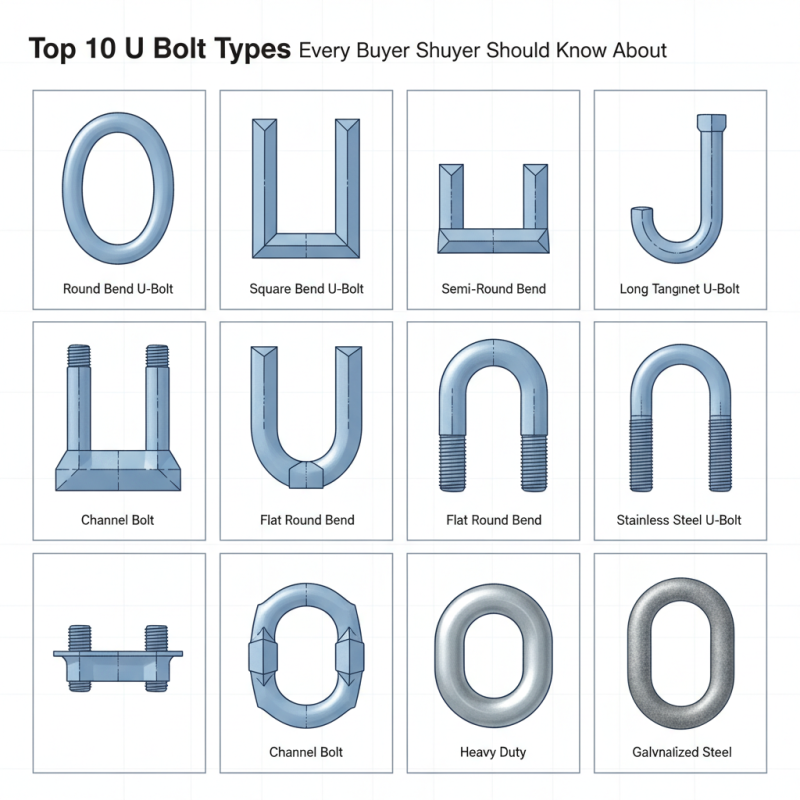
U-bolts are vital components in various applications, supporting structures and securing pipes. Understanding the different types of U-bolts is crucial for making informed decisions. There are two main categories: round and square. Round U-bolts are ideal for securing cylindrical objects. They distribute stress evenly and prevent damage. Square U-bolts, however, provide better grip on flat surfaces. Both types serve specific needs, depending on the application.
In construction, U-bolts are essential for anchoring columns and beams. They withstand various loads and resist bending. Choosing the right type impacts safety and durability. Galvanized U-bolts resist corrosion, making them suitable for outdoor use. Stainless steel options offer even greater resistance, ensuring longevity. Installing U-bolts requires attention to detail. Proper size and alignment are crucial for optimal performance. Skipping these steps may lead to failure, risking structure integrity.
This chart illustrates the importance and applications of various U bolt types based on their usage in different industries. Each U bolt type is represented by its frequency of application across sectors such as automotive, construction, and manufacturing.
U bolts are essential components in various applications, ranging from automotive to construction. When selecting the right U bolt, understanding the material variations is crucial. Steel, stainless steel, and galvanized U bolts each offer unique benefits and limitations.
Steel U bolts are strong and durable. They are often used in heavy-duty applications. However, they may rust easily if exposed to moisture. This is a significant consideration for outdoor use. On the other hand, stainless steel U bolts provide excellent corrosion resistance. They are ideal for marine environments or areas with high humidity. The trade-off is that stainless steel can be more expensive than steel.
Galvanized U bolts strike a balance between cost and performance. They are coated with zinc to resist rust and corrosion. This makes them suitable for a variety of conditions, although the coating can wear away over time. Buyers should consider expected exposure to elements and choose a material accordingly. Each option has its pros and cons, requiring thoughtful evaluation based on intended use.
| U Bolt Type | Material | Typical Applications | Corrosion Resistance |
|---|---|---|---|
| Standard U Bolt | Steel | General fastening in construction | Low |
| Heavy Duty U Bolt | Stainless Steel | Truck and trailer applications | High |
| Galvanized U Bolt | Galvanized Steel | Outdoor equipment | Moderate |
| Square U Bolt | Steel | Furniture assembly | Low |
| U Bolt with Plate | Stainless Steel | Sign and fence installation | High |
| Short U Bolt | Galvanized Steel | HVAC applications | Moderate |
| Long U Bolt | Steel | Automotive and marine | Low |
| Custom U Bolt | Stainless Steel | Industrial applications | High |
| Plastic Coated U Bolt | Galvanized Steel | Electrical installations | Moderate |
| Auto-Adjustable U Bolt | Stainless Steel | Custom machinery | High |
When it comes to U-bolts, understanding the different shapes and sizes is essential. These components are available in several standard configurations. The most common shape is the classic U, which features a symmetrical design, making it ideal for secure fastening. This shape provides stability, especially in heavy-duty applications like automotive and structural support.
Different sizes of U-bolts cater to various needs. Common diameters range from 1/4 inch to 1 inch. The length can also vary significantly. Those intended for regular tasks may only need a few inches. More specialized applications, however, often require longer bolts. Each size and shape hold unique properties, influencing their applications and effectiveness. It’s crucial to select the right type to avoid potential failures or safety hazards.
Choosing the wrong U-bolt can lead to improper fits. This can create stress points in a structure. Using a U-bolt that is either too small or too large may not provide the necessary strength. Without proper research, buyers risk making choices that do not meet their project requirements. The knowledge of standard configurations helps buyers make informed decisions. Recognizing the specific needs of their projects contributes to overall reliability and safety.
When selecting U bolts, understanding coatings and finishes is essential for enhancing durability and corrosion resistance. Many buyers overlook this aspect, yet studies show that inadequate protection can lead to increased maintenance costs and decreased lifespan. For instance, untreated U bolts may rust within six months, while properly coated versions can last several years.
Common coatings like zinc plating and powder coating significantly improve resistance to corrosion. Reports indicate that galvanized U bolts can resist corrosion 10 times longer than those without any protective layer. Additionally, specific finishes can withstand harsh environmental conditions, including exposure to saltwater and industrial chemicals. However, not all coatings are created equal. Some coatings may chip or wear off, leading to premature failures.
It is crucial to select a U bolt with the appropriate coating for your specific application. A mismatch can lead to unexpected wear and failures. Proper research on material compatibility and finish options can save time and resources in the long run. Remember to consider the environmental conditions your U bolt will face, as this plays a critical role in choosing the right finish.
When selecting a U bolt, several critical factors should guide your decision. Material choice is paramount. U bolts come in various materials, including steel, stainless steel, and plastic. Each has unique properties and applications. Steel offers high tensile strength, ideal for heavy-duty use. However, it may corrode in adverse environments unless galvanized. According to industry reports, choosing the right material can improve durability and longevity by up to 30%.
Size is another crucial consideration. U bolts are available in varying diameters and lengths. A proper fit is essential for structural integrity. Up to 25% of U bolt failures arise from incorrect sizing. It's vital to measure the application area accurately before purchase. Incorrect dimensions can lead to expensive repairs and potential safety issues. Many users overlook the impact of load ratings as well. The right U bolt should meet or exceed the load demands of your project.
Lastly, understand the intended application. Different projects require specific U bolt types. For example, automotive U bolts differ from those used in construction. Research reveals that misapplication accounts for nearly 18% of equipment failures in various industries. Therefore, aligning your U bolt selection with project needs is critical.
How can we help you?
Call to 0034 943884600 Contact usWe use cookies to ensure that we give you the best experience on our website. If you continue without changing your settings, we'll assume that you agree to receive cookies on the HINE website. For more information read our cookie policy page, click the link for more information.plugin cookies
ACEPTAR