What Is Hydraulic Fluid and Which Type Do You Need?
Hydraulic fluid is more than the liquid moving through a machine. It lubricates pumps and valves, carries heat away, and helps transmit force. Choose the wrong type, and the consequences can appear gradually: a pump grows louder, seals begin to seep, or response becomes sluggish on a cold morning. The correct choice depends on the equipment maker’s specifications, operating temperature, pressure, and environment—not simply the fluid’s color or price.
Fluid-power author John S. Cundiff is a recognized technical voice in hydraulic systems. Rather than assign him an unverified quotation, this introduction summarizes a practical principle consistent with fluid-power engineering: “Match the fluid to the system’s design and operating conditions.” That is a paraphrase, not a direct quotation. It matters because fluids differ in viscosity, additive chemistry, and compatibility with seals and components. A product suitable for one excavator may be unsuitable for another machine, even if both use similar-looking reservoirs.
This guide explains what hydraulic fluid does and how common options differ, including mineral-based, synthetic, and biodegradable formulations. It also considers viscosity grades, temperature ranges, and manufacturer recommendations. Start with the equipment manual and the label on the existing reservoir. Check carefully. A small detail, such as a required viscosity grade, can change performance. And when the manual is unclear, guessing is not expertise; confirm the specification with the equipment manufacturer or a qualified service professional.
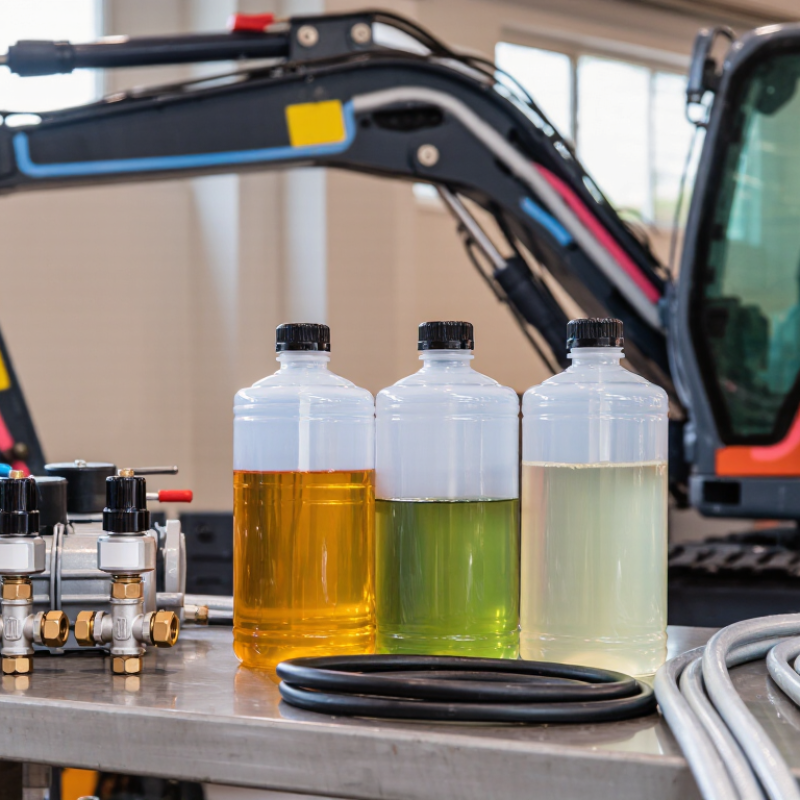
What Hydraulic Fluid Does: Power Transfer, Lubrication, and Heat Removal
Hydraulic fluid is more than a liquid pushed through hoses. It carries force from a pump to cylinders and motors, letting a compact machine lift, steer, or clamp. When a valve redirects the flow, pressure changes help control movement. The fluid itself does not create power; it transfers energy supplied by the pump. That distinction matters when a system feels weak. A leak, worn component, or clogged filter may be the real cause.
It lubricates moving surfaces inside pumps, valves, and motors, reducing friction and wear. It also carries heat away from working parts and toward the reservoir, where some heat can escape. Under heavy use, fluid can become hot and thin, which may reduce protection and make performance less predictable. Not ideal. Cleanliness matters too: tiny particles can damage close-fitting components, even when the fluid looks clear. I have found that appearance can be misleading. Choosing a fluid means checking the equipment maker’s viscosity and compatibility requirements, then considering the machine’s temperature range and workload. The right fluid supports all three jobs, but it cannot compensate for poor maintenance or a failing seal.
How ISO 3448 Defines Hydraulic Oil Grades by Viscosity at 40°C
Hydraulic fluid transfers power, lubricates moving parts, and carries heat away from pumps and valves. Its performance depends heavily on viscosity, especially during cold starts and heavy operation. ISO 3448 classifies hydraulic oil by kinematic viscosity measured at 40°C. The grade is called ISO VG, or viscosity grade.
ISO VG 32 has a nominal viscosity of 32 mm²/s at 40°C. ISO VG 46 measures about 46 mm²/s, while ISO VG 68 measures about 68 mm²/s. These values are reference points, not exact guarantees under every condition. Temperature changes viscosity quickly. A fluid that feels suitable at 40°C may become sluggish on a cold morning. A practical check includes the machine’s operating temperature, pump design, pressure, and manufacturer requirements.
Choose too low a grade, and internal leakage may increase. Lubrication can also weaken. Choose too high a grade, and startup may become slow, with extra resistance and possible cavitation risk. Not every hydraulic fluid with the same ISO VG performs identically. Additive packages, base oil quality, cleanliness, and oxidation resistance also matter. The label helps, but it does not tell the whole story.
A careful technician compares the ISO VG rating with the service manual and actual working conditions. Small differences matter. One overlooked detail is seasonal temperature. That is where a seemingly correct choice can fail.
ISO 3448 Hydraulic Oil Grades at 40°C
ISO VG grades identify the nominal kinematic viscosity of hydraulic oil in mm²/s (cSt) at 40°C. A higher ISO VG number indicates a thicker oil. The correct grade depends on the equipment manufacturer’s specification, operating temperature, and system design.
Values shown are nominal ISO VG viscosities at 40°C. Common hydraulic grades are displayed for comparison.
Which Fluid Types Suit Mineral-Oil, Water-Glycol, and Biodegradable Systems
Hydraulic fluid transfers power, lubricates moving parts, and helps carry heat away. The right choice depends on the system’s seals, operating temperature, and equipment requirements—not just the fluid’s label.
Mineral-oil fluids suit many conventional hydraulic systems and offer dependable lubrication. Check the equipment manual for the required viscosity and additive specification. Water-glycol fluids contain water, so they can provide fire resistance in suitable applications. They may need closer attention to corrosion protection, temperature limits, and water content. Biodegradable fluids can reduce environmental persistence if leaks occur, but the category includes different base oils and performance properties. Some may be incompatible with existing seals or residual fluid. Compatibility matters.
Tips: Verify the fluid specification before topping up, and avoid mixing types unless the manufacturer confirms they are compatible. Inspect for leaks, foaming, or unusual heat after a change. Small details count. A fluid described as biodegradable is not automatically suitable for every machine or environment. I would treat that label as a starting point, not a complete answer.
How to Match Fluid Viscosity to Pumps, Seals, and Operating Temperatures
Hydraulic fluid transmits force, lubricates moving parts, and carries heat away from components. Choosing it by viscosity alone can be misleading. The right fluid must suit the pump design, seal materials, and temperature range specified for the equipment.
Viscosity changes with temperature. A fluid that flows well in a cold workshop may become too thin after hours of heavy operation. Thin fluid can weaken the lubricating film and increase internal leakage. Fluid that is too thick may cause sluggish starts, noisy pumps, or difficult suction. Check the equipment manual for the required viscosity grade and operating limits. Then consider the coldest start and the hottest sustained condition, not just the room temperature. Small details matter.
Pump type also affects the choice. Vane, piston, and gear pumps can have different viscosity requirements, so confirm the limits for the exact pump. Seals matter too: some elastomers tolerate certain fluid families better than others. If seals swell, harden, or begin to leak, compatibility may be part of the problem. I would not diagnose that from appearance alone; check service records and consult qualified maintenance guidance. When conditions vary widely, an appropriate viscosity index may help maintain more stable flow, but it cannot replace the manufacturer’s specifications.
How ISO 4406’s Three-Part Code Specifies Hydraulic Fluid Cleanliness
Hydraulic fluid cleanliness is measured by particle counts, not by how clear the oil looks in a sample jar. ISO 4406:2021 assigns a three-part code for particles larger than 4, 6, and 14 micrometres, respectively. Each number represents a count range per millilitre. Higher numbers mean more particles.
Small particles matter.
For example, an ISO code of 18/16/13 indicates approximately 1,300–2,500 particles above 4 μm(c), 320–640 above 6 μm(c), and 40–80 above 14 μm(c) per millilitre. These ranges follow the ISO 4406 coding table. The figures help technicians compare samples and check whether fluid meets the equipment maker’s cleanliness target.
A fresh-looking fluid can still exceed that target. Not the whole picture. The code does not identify particle types, water, or air, so it should be read alongside other fluid tests.
Sampling also matters: a dirty bottle or unrepresentative sample can distort the result. The right cleanliness level depends on the system’s components and operating conditions, not a universal “clean” number.